The Feeling Inside "Ancient Kahiko Chant"
Stone walls around you, generations behind you. The pahu strikes and the ground answers through your feet — this is not a performance you watch, it is a formation you join, shoulder to shoulder with ancestors you cannot see but can suddenly feel.
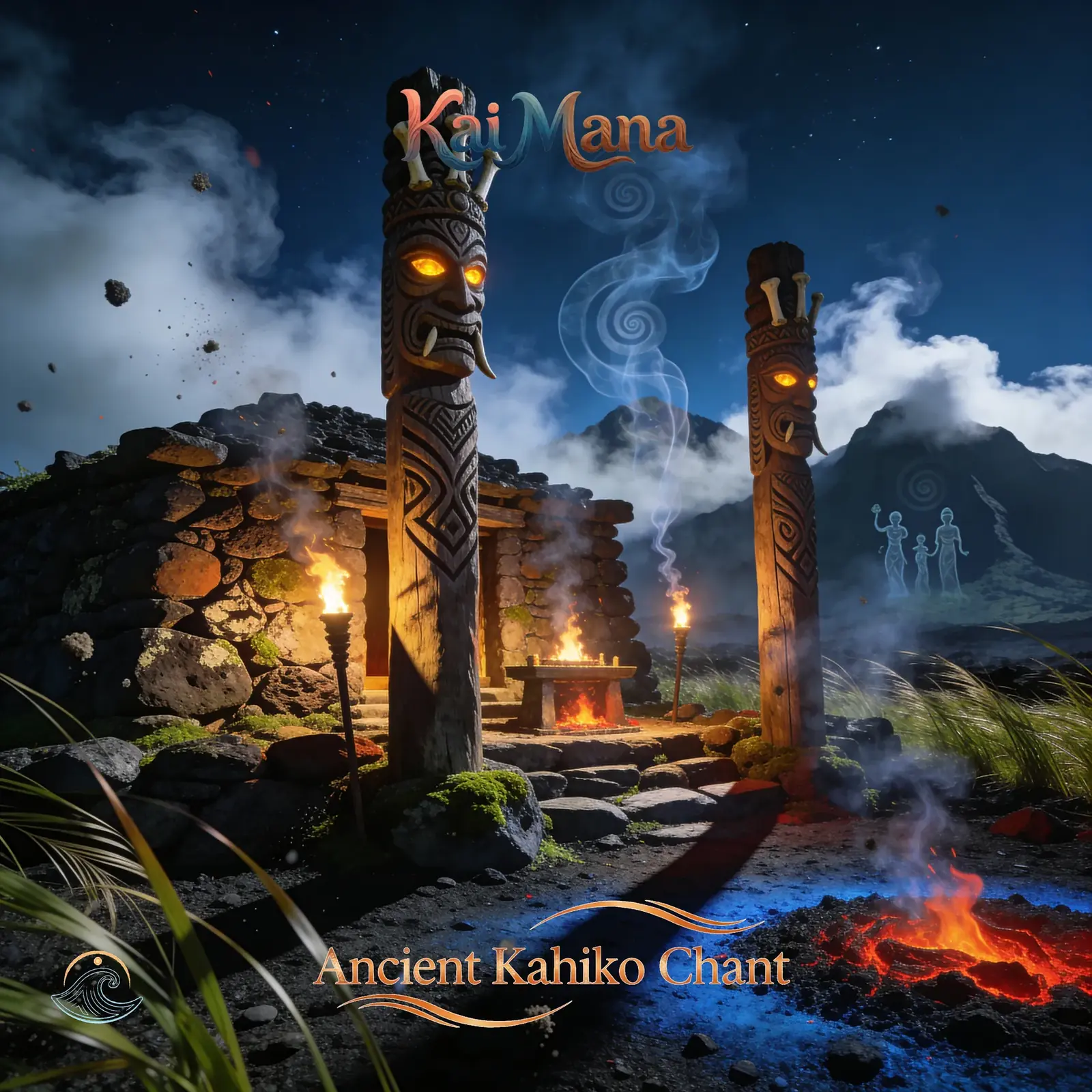
This is the fiercest chant on the album — the kahiko, the ancient form of hula, where the past is not remembered but summoned. Its core truth: the ancestors are not behind us. They live right now, inside the wind, the sea, and the blood.
Where the Song Takes You
The chant opens with a summons to the lineage: "E kū mai, e nā kūpuna / E ala mai, e ka ʻāina" — arise, ancestors; awaken, living land. This is the protocol of the heiau, the temple: before anything can be asked, those who came before must be called to witness.
Then the chant turns outward, commanding the elements one by one. The wind (makani) is told to sound. The waves (nalu) are told to rise. The sun (lā) and moon (mahina) are asked to shelter and sustain. Each element answers through the ensemble's roaring response — Hōʻoho! Hāpai! — the voice of ancient times answering in the present tense.
The final movement seals the covenant: blessings asked from the gods (nā akua) and the earth (ka honua), returned as eternal blessing (ka pōmaikaʻi mau loa). The last shout is flung into the air — and then the voices let go. The pahu carries the ending alone, faster and faster, until one final strike cuts it clean. The sound of a people still standing, and the drum that stands with them.
How It Sounds
It begins with a voice alone — no drum, no accompaniment, the opening call carried on breath and conviction. Fifteen seconds in, the pahu lands: a deep, thunderous skin drum that gives the chant its physical weight, anchoring the ~112 BPM cadence like measured footwork on stone. That is the whole band — voices and one great drum. Nothing here is decorative. Every sound is a footstep.
The lead chanter — guttural, chest-driven — commands like someone addressing the elements directly, not singing about them. At 0:24 the full ensemble joins in roaring unison, the vocal equivalent of a formation moving as one body. Then, at 1:16, the rhythm stops entirely: the voices hold a sustained, multi-part harmony swell — the whole chant hanging in midair — before a shouted reset hurls it back into motion. And at the end, after the final vocal shout, the voices simply release: the pahu drives on alone, accelerating into the closing strike, the ancestors left dancing in the drum.
The Journey Through the Song
- 0:00 – 0:24 · The Ancestral Awakening Summoning the lineage A cappella opening — the lead chanter calls alone: "E kū mai, e nā kūpuna / E ala mai, e ka ʻāina..." At 0:15 the deep pahu enters underneath; at 0:24 the full ensemble joins with force.
- 0:25 – 0:54 · Ensemble Response & Wind Invocation The voice of ancient times "Kū mai! Ala mai!" the ensemble roars back, then the call goes to the elements: "E hoʻōho, e ka makani / E hāpai, e ka nalu..."
- 0:55 – 1:32 · The Power of Sea & Sky Commanding the elements — then silence "Hōʻoho! Hāpai! Ka mana o ke kai..." — the raw power of the ocean called forward. At 1:16 the rhythm halts: voices sustain a multi-part harmony swell, the chant suspended in midair. A shouted "Hey! Hey! Hey!" at 1:23 hurls it back into motion.
- 1:33 – 2:06 · Blessings of Earth & Gods The covenant sealed "E hoʻomaikaʻi, e nā akua / E hoʻomaikaʻi, e ka honua..." The full chant drives forward again as blessings are exchanged between gods, people, and earth.
- 2:07 – 2:45 · The Drum Alone Percussion-only finale The voices release after the final shout. The pahu drives on alone — fast, relentless, accelerating — until one final strike at ~2:41 cuts the chant clean.
Images the Song Carries
- walking pace tempo
- guttural voice
- ancient storytelling
- deep lineage
Moments to Catch
Lyrics
E kū mai, e nā kūpuna!
E ala mai, e ka ʻāina!
[Response]
Kū mai! Ala mai!
Ka leo o ka wā kahiko!
[Call]
E hoʻōho, e ka makani!
E hāpai, e ka nalu!
[Response]
Hōʻoho! Hāpai!
Ka mana o ke kai!
[Call]
E pūlama, e ka lā!
E mālama, e ka mahina!
[Response]
Pūlama! Mālama!
Ka mālamalama o ke ao!
[Call]
E hoʻomaikaʻi, e nā akua!
E hoʻomaikaʻi, e ka honua!
[Response]
Hoʻomaikaʻi! Hoʻomaikaʻi!
Ka pōmaikaʻi mau loa!