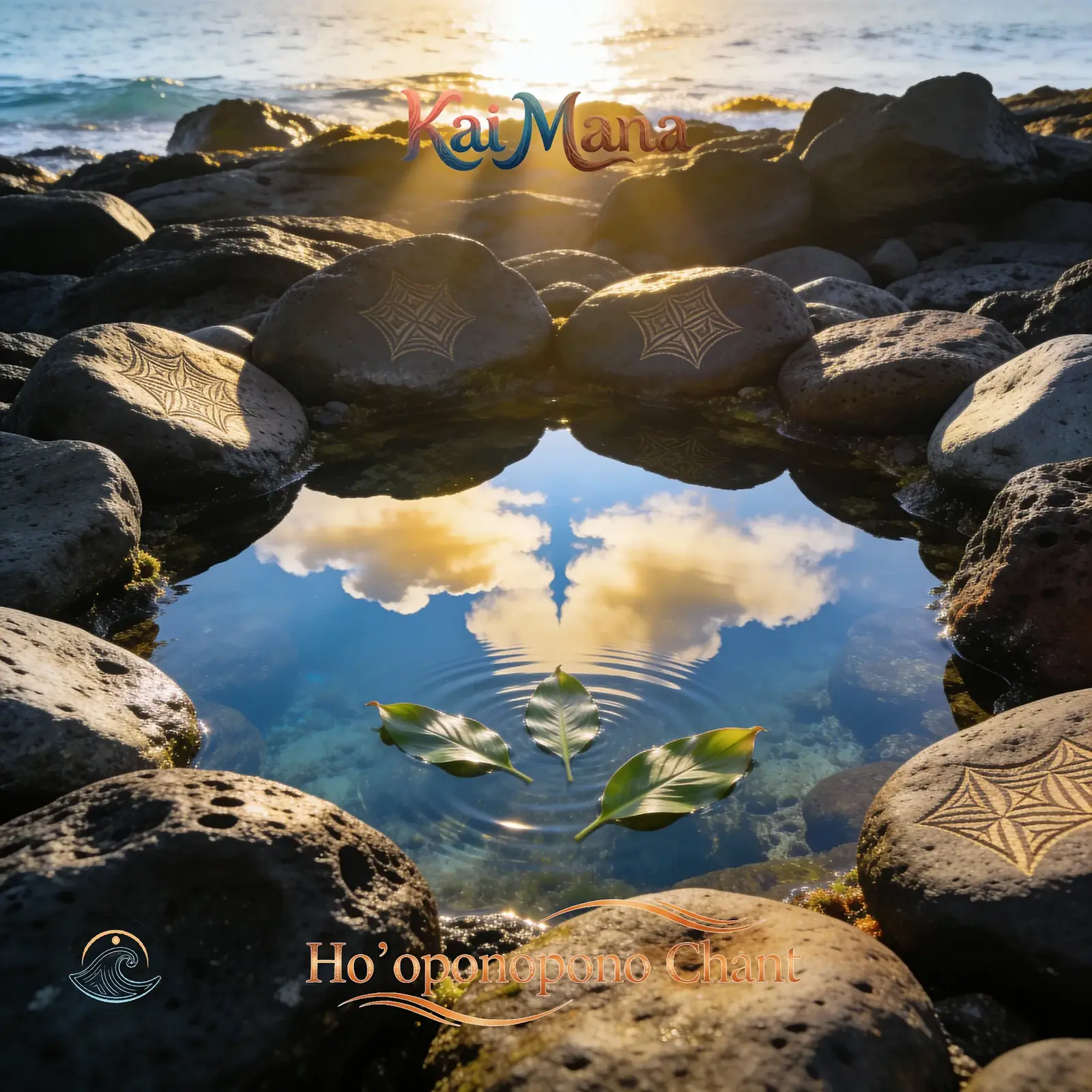
The Feeling Inside "Hoʻoponopono Chant"
A drumbeat like a slowed heart. Silence held long enough to feel its weight. Then voices — low, deliberate, breathing — asking not for forgiveness exactly, but for something older: the untying of knots.
This is the spiritual cleansing chamber of Chants. Hoʻoponopono — the ancient Hawaiian practice of reconciliation and release — is not a performance. It is a process. The chant moves at a resting-heartbeat ~76 BPM half-time pulse, because that is the speed at which real letting go happens. A single deep pahu joins the voices at around 0:12 and stays with them to the end — but the space between the felt beats is where the healing lives.
Where the Song Takes You
The chant opens with voices alone — no drum, no instruments — the ensemble breathing together: "Hoʻoponopono e hoʻi i ke kumu" — return to the source. In Hawaiian, kumu means teacher, origin, and the trunk of a tree all at once. Healing, in this tradition, is not about fixing what is broken. It is about going back to the self that existed before the conflict — the untarnished root.
Then comes the emotional center: "Ua hala au — e kala mai". Commonly translated as "I am sorry," kala literally means to unloose, to untie. The cords — huka — that bind people to past pain are not cut in anger. They are loosened, patiently, with breath. The repetition is the point: some knots take more than one pass.
From there the chant widens. Gratitude to the divine for the lessons struggle teaches. Then love — first personal (aloha wau iā ʻoe), then collective (aloha wau iā mākou), then planetary (aloha i ka honua). Hoʻoponopono does not end with the self. It ends with the world put right — pono — alignment restored between person, family, ancestors, and earth.
How It Sounds
Heavy and warm at once. The ensemble opens a cappella — male and female voices in close harmony, no instruments at all. At around 0:12 a muffled pahu joins and pulses like a heartbeat you feel in your chest more than hear — soft, deep, grounding. There is no guitar, no ukulele, no synth pad: the voices themselves carry the harmony, and the pahu carries the time.
The vocals — ʻAukai, Kaimana, Lehua, Makani, and Makua Nui together — are phrased with deep breath control, hā, the breath of life. Declarations are followed by real silence, long enough for the emotional weight to settle before the next line arrives. This is the slowest-feeling chant on the album, and the space between the notes is where the healing lives.
The Journey Through the Song
- 0:00 – 0:18 · Invocation of Alignment Return to the source A cappella opening — voices alone: "Hoʻoponopono hoʻo i ka pono / Hoʻoponopono e hoʻi i ke kumu..." Around 0:12 the deep pahu heartbeat joins underneath. The standard of absolute authenticity is set.
- 0:19 – 0:42 · The Sacred Release E kala mai — untying the knots "Ua hala au — e kala mai..." Vulnerable repetition acknowledging error and asking for release. The emotional center of the chant.
- 0:43 – 1:04 · Gratitude to the Divine Thanks for the lessons "Mahalo ke Akua no ke aʻo ʻana..." The vocal texture warms and rises — gratitude for what struggle teaches.
- 1:05 – 1:24 · Universal Love Aloha i ka honua "Aloha wau iā ʻoe... aloha i ka honua..." Love expands from the personal to the collective to the entire living earth.
- 1:25 – 1:38 · Final Blessing Sacred stillness "Hoʻoponopono e hoʻopono i ke ola / i ka honua..." A hushed resolution. The pahu lands one final strike around 1:34; a brief rustling decay trails for a few seconds, then profound quiet.
Images the Song Carries
- forgiveness
- reconciliation
- meaningful pauses
- sacred silence
Moments to Catch
Lyrics
Hoʻoponopono, e hoʻi i ke kumu.
Ua hala au — e kala mai.
Ua hala au — e kala mai.
Mahalo ke Akua no ke aʻo ʻana,
Mahalo ke ao, mahalo ke ao.
Aloha wau iā ʻoe, aloha wau iā ʻoe,
Aloha wau iā mākou, aloha i ka honua.
Hoʻoponopono, e hoʻopono i ke ola,
Hoʻoponopono, e hoʻopono i ka honua.