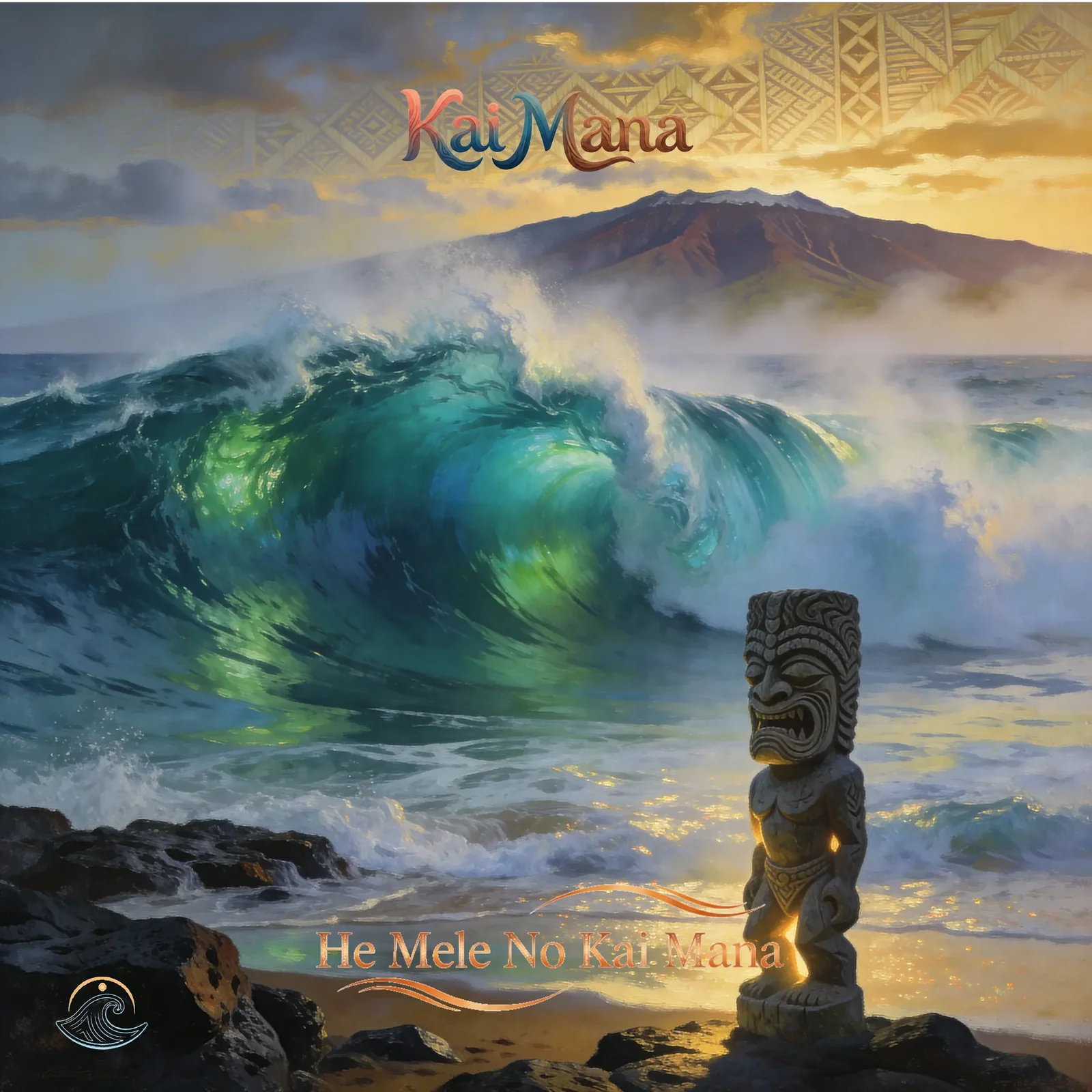
The Feeling Inside "He Mele No Kai Mana"
You are standing at the water's edge before dawn. A low drone swells — distant, deliberate — and voices rise out of the stillness like something the sea has been holding back for generations.
This is the opening ceremony of Chants — a mele inoa, a name song, the most honorific form in the Hawaiian chant tradition. It does not entertain. It invokes. Before Kai Mana can be a band, a story, or a sound, it is a name spoken correctly, with breath and intention, at the boundary between land and sea.
Where the Song Takes You
The chant begins with a summons: "Ea mai! Ka leo o ke kai!" — arise, the voice of the sea. What follows is gratitude offered in the old order: first to the deep ocean itself, then to the power of the returning wave, then to Maui — the green slopes, the indigo channel waters.
From the shoreline the chant climbs. "Mālamalama i ke one / A ka luna o Ka Haleakalā" — light on the sand, and above it, the summit of Haleakalā catching first sun. This is the mauka-to-makai axis that runs through all of Kai Mana's work: everything sacred here moves between mountain and sea, and the chant traces that path with voices.
The final section turns the name itself into a declaration. "ʻO Kai Mana! He inoa! Kūlele!" — Kai Mana! A name! It stands on its own! In the mele inoa tradition, speaking the name with full power is what gives the thing its life. The album starts here because everything else — every song, every character, every story — depends on this name being spoken right.
How It Sounds
Slow as tide. The pahu drums sit deep and wide apart — not a beat you follow but a ground you stand on, each strike resounding like something tectonic. Over them, the ipu heke keeps a hollow, breathing pulse, and underneath everything a sub-bass synth drone sustains — a low floor gluing the organic percussion to the vocal harmonics.
The voices arrive in the old way: chest-rooted, unhurried, rich with the microtonal vibrato of the ʻoli tradition. Kaimana, ʻAukai, and Makua Nui open with reverent baritone and tenor invocations; Lehua and Makani answer with harmonic lines that soar without ever leaving the ceremony. Nothing is rushed. At ~64 BPM half-time pulse, the chant moves at the pace of breath, not performance — the ipu and vocal subdivisions riding at ~128 BPM double-time underneath.
The Journey Through the Song
- 0:00 – 0:20 · Opening The drone and the deep drum Deep pahu rumble under a rising drone. The voices call the opening invocation: "Ea mai! Ka leo o ke kai / He mele inoa no Kai Mana..." — the ceremony begins at the waterline.
- 0:21 – 0:52 · Oli of Gratitude Thanks to the deep ocean Reverent lines honor Maui's green slopes and indigo waters: "Nui ke aloha i ka moana hohonu..." The voices move like swells — rising, cresting, returning.
- 0:53 – 1:24 · Haleakalā Invocation Light climbs the mountain The chant welcomes the morning sun over the summit. Vocal intensity expands — the female chorus enters, slow and swelling, as the light reaches the sand.
- 1:25 – 1:58 · Guidance of the Stars The navigators' verse Deep resonant harmonies hold space for the evening stars that lead fishermen home through the channels. The ancestors are not remembered here — they are present.
- 1:59 – 2:32 · Declaration & Recessional The name stands "ʻO Kai Mana! He inoa! Kūlele!" — the full ensemble declares the name at full power, then the drums fade back into low drone resonance. The sea keeps what it was given.
Images the Song Carries
- rising falling voices
- tidal momentum
- slow intention
- sacred space
Moments to Catch
Lyrics
He mele inoa no Kai Mana!
Nui ke aloha i ka moana hohonu!
Ka mana o ka nalu, hoʻi mai e!
Ua wehi ʻia i ka ʻōmaʻomaʻo o Maui,
I ka uliuli o ka Moana.
[Verse 1]
Mahalo nui iā ka Lani-Lā,
Hōʻike mai ana lā i ka nani.
Ka piʻi ʻana mai o ka nalu,
E kū ana i ka pali o ka papa heʻe nalu.
Mālamalama i ke one,
A ka luna o Ka Haleakalā.
[Interlude – female chorus, slow & swelling]
E nānā nā maka i ke kai-mana...
Nā hōkū o ke ahiahi,
Ke alakaʻi ʻana i ka poʻe lawaiʻa.
[Verse 2 – faster]
He inoa no ke kumu o ke ola,
ʻO ke kai-mana, ka ikaika.
Ka leo o ka puʻu, kani mau,
I ka nahenahe o ke mele a Hawaiʻi.
[Unison – full power]
ʻO Kai Mana! He inoa!
Kūlele!