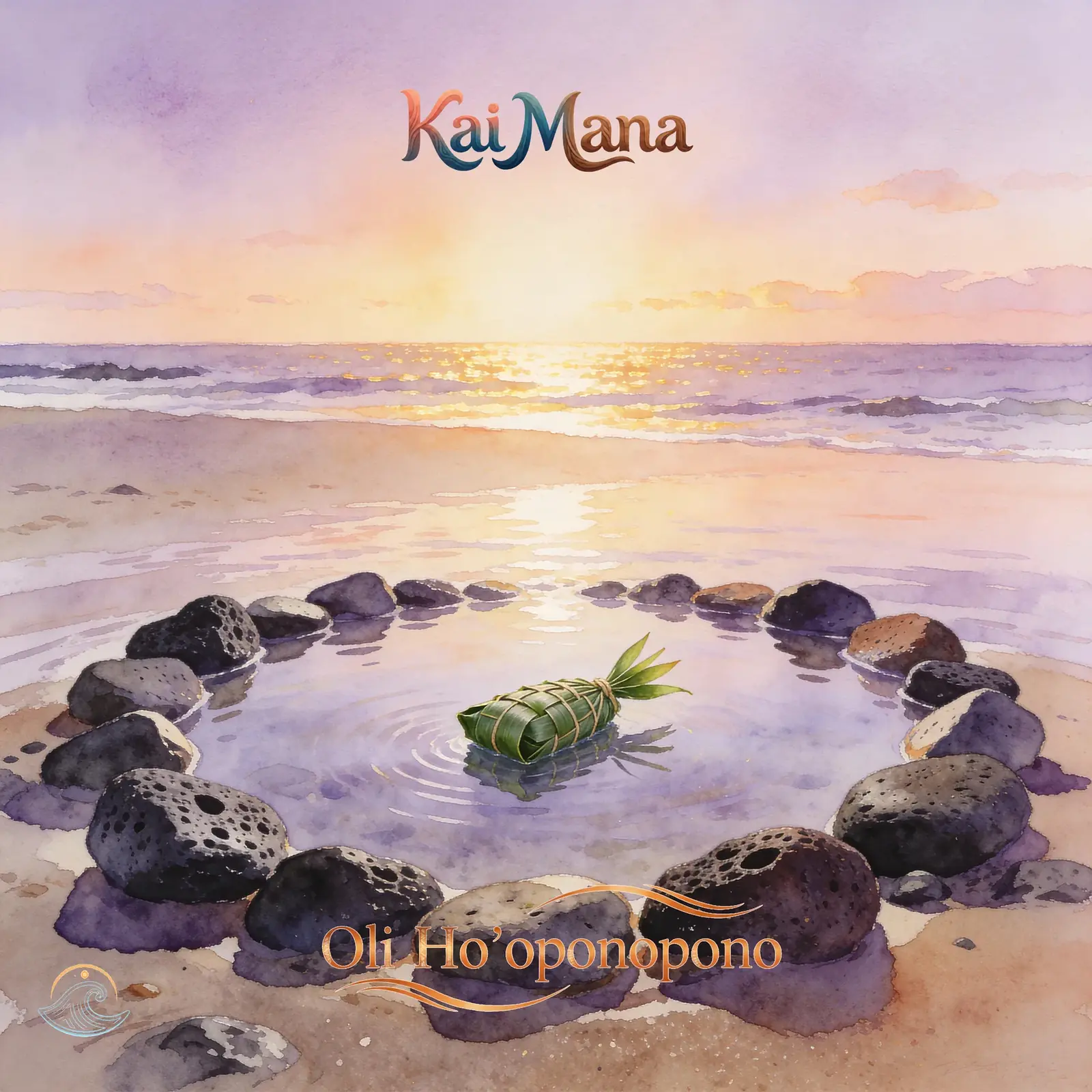
The Feeling Inside "Oli Hoʻoponopono"
Late at night, after the ceremony. The fires are down to embers, the stars are out, and one weathered voice — the elder's — begins a prayer so quiet it could be mistaken for breathing. Then, gently, the whole family joins.
This is the final blessing of Chants — the album's epilogue. Where track 3 performed hoʻoponopono as ceremony, this oli performs it as prayer: breath-paced, carried on layered voices over a soft ipu heartbeat. It sends you back into the world renewed, grounded in pono — rightness.
Where the Song Takes You
The entire prayer is built from three pillars, repeated like breath: ua hala au — e kala mai (I have strayed — untie the knots), mahalo (gratitude), aloha (love). Release, thanks, love — in that order, because the Hawaiian understanding is that you cannot arrive at love without first passing through release and gratitude.
Makua Nui, the elder guardian, opens alone — a solitary voice in hushed reverie. This is how the practice actually happens: not on a stage, but at the end of the day, one person accounting for themselves. Then the rest of the Kai Mana family joins in gentle unison, because healing that stays private stays unfinished. The ʻohana heals together or not at all.
The deepest teaching of the oli is in its form: hoʻoponopono is not a one-time ceremony but a daily return to equilibrium. The knots of anger, grievance, and fear are remembered as illusions and dissolved into light and breath. The voices exhale together at the end — not an ending, but a rest. The practice resumes tomorrow.
How It Sounds
Almost nothing — and that is everything. The oli keeps only what a prayer needs: layered vocal resonance, a soft ipu heartbeat marking the breath, and the natural space around them — a soft ocean breeze, the distant rustle of leaves, gentle nocturnal waves. At ~54 BPM half-time pulse — with the vocal phrasing subdividing at ~108 BPM double-time — it is the slowest, quietest track on the album: prayer tempo, breath tempo.
Makua Nui's weathered solo voice carries the opening with unadorned sincerity and gentle vibrato — the sound of someone who has said these words ten thousand times and means them more each time. When Lehua, Kaimana, Makani, and ʻAukai join in soft unison, the effect is not volume but depth: a family breathing together.
The Journey Through the Song
- 0:00 – 0:22 · The Intimate Opening The elder's voice Makua Nui's solitary, weathered voice enters in hushed reverie: "Hoʻoponopono e, hoʻo i ka pono / Ua hala au — e kala mai..." — sacred trust established.
- 0:23 – 0:50 · Gratitude & Love Mantra The breath cycle "Mahalo, mahalo / Aloha, aloha..." The phrasing feels like slow, conscious breathing — release, thanks, love, repeat.
- 0:51 – 1:20 · Ensemble Unison Echo The family joins Lehua, Kaimana, Makani, and ʻAukai softly join in gentle unison — communal solidarity, shared forgiveness, one breath.
- 1:21 – 1:44 · Final Breath & Sacred Rest The exhale "Hoʻoponopono e, e hoʻopono i ke ola..." The voices gently exhale together, tapering into total silence and the quiet hum of the night.
Images the Song Carries
- quiet blessing
- prayerful resolution
- calm reflection
- sacred rest
Moments to Catch
Lyrics
Ua hala au — e kala mai.
Ua hala au — e kala mai.
Mahalo, mahalo!
Aloha, aloha!
Hoʻoponopono e, e hoʻopono i ke ola!