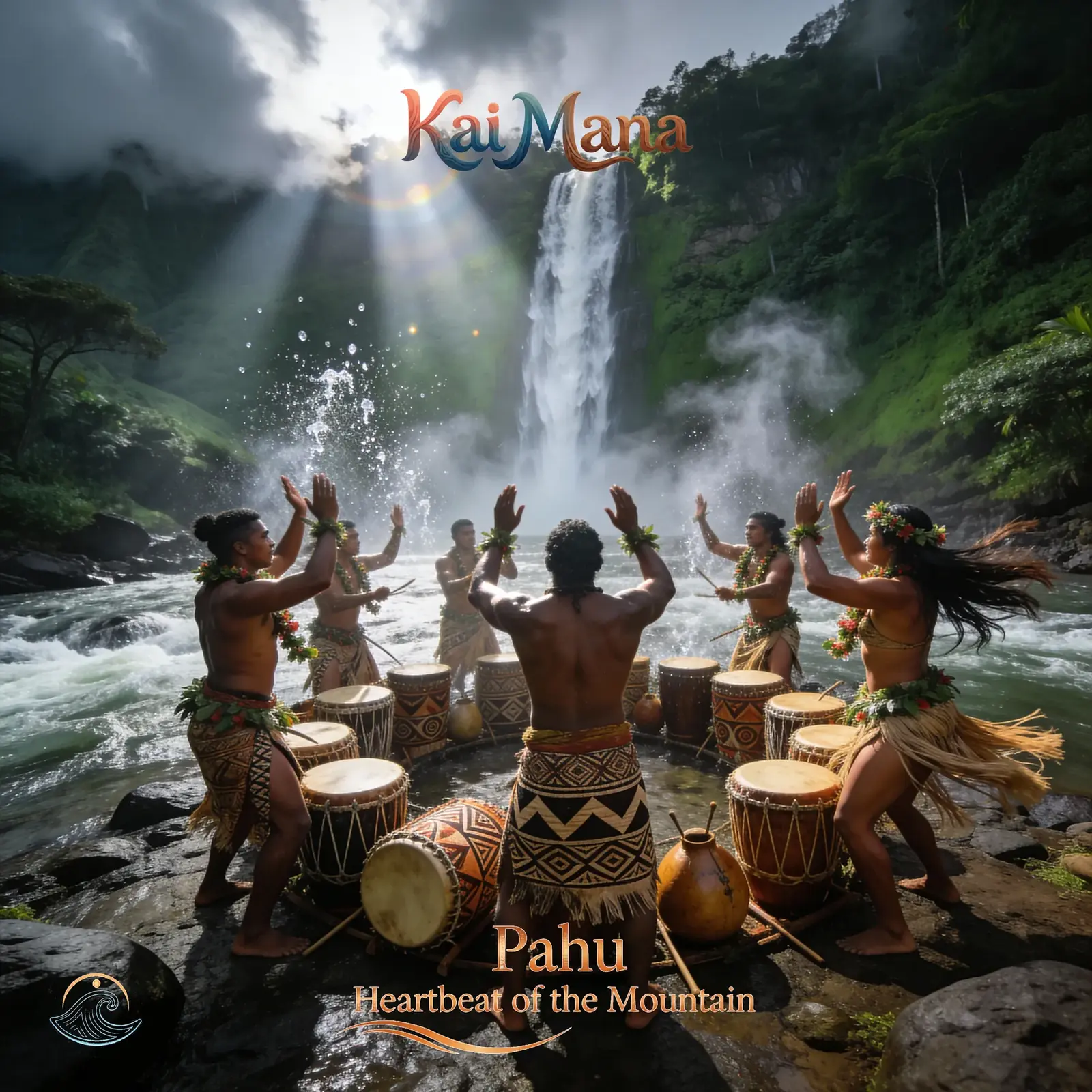
The Feeling Inside "Pahu – Heartbeat of the Mountain"
You are standing at the crater rim of Haleakalā. The clouds part over red and black cinder cones, and then the first pahu strike lands — so deep it arrives through the soles of your feet before it reaches your ears. The mountain has a heartbeat. You just heard it.
This is the grounding anchor of Chants — the track that connects the album's ceremonies to the land itself. In Hawaiian belief, the pahu drum carved from ancient trees is not an instrument. It is ka leo o ka honua — the voice of the earth — and this chant lets the mountain speak.
Where the Song Takes You
The chant opens with the voice alone — Makua Nui's solitary invocation echoing across silent space: "Pahu... Pahu ka honua" — the drum, the drum of the earth. The great stones (pōhaku nui) and the cliffs (pali) are named, and the ancestors who guard them: nā kūpuna e kiaʻi nei — the elders who stand watch. The voice sets its own metered rhythm first — nearly a minute of pure chant before the first seismic pahu strike lands at 1:09, and the mountain finds its heartbeat.
Then the chant reaches back to the beginning of everything: "Ua hānau i ka pō / Ua kū i ka ao mālamalama" — born in the primordial night, standing in the brilliant light of day. This is the language of the Kumulipo, the Hawaiian creation epic: the islands themselves were born out of cosmic darkness, volcanic and alive, and the mountain has been standing ever since.
The climax is a single command repeated like a vow: e hoʻomau — persevere, continue, hold on. The full ensemble roars it with fierce conviction, because this is the core truth of the chant: the mountain did not ask permission to stand, and neither does the culture it watches over. Then the drums stop — and one final spoken command hangs in the air: e hoʻo makaukau — prepare yourself, make ready. The mountain's last word is not a drum. It is a vow.
How It Sounds
Geological — but patient. The first minute is voice alone, a free rhythm that hardens into a metered chant before any drum sounds. Then the pahu lands at 1:09: monumental resonant skin strikes delivering deep subterranean bass impacts that mimic the tectonic pulse of Haleakalā, driving the ~73 BPM half-time heartbeat with ~148 subdivisions. A possible second percussion — perhaps an ipu — rides alongside, though the pahu so fully dominates the mix that no secondary instrument can be confirmed.
The vocals open with a solitary invocation — Makua Nui alone, authoritative, echoing across silent space — building into a metered chant long before the ancestral warrior chorus answers in unison roar. When the full ensemble peaks in the climax, it does not sound like a choir. It sounds like the mountain itself erupting. And at the very end, after the drums have already gone quiet, one last spoken command — e hoʻo makaukau — is left ringing with no drum beneath it.
The Journey Through the Song
- 0:00 – 0:19 · Solitary Opening Oli The mountain speaks first Makua Nui delivers the free-rhythm solo invocation: "Pahu... Pahu ka honua! Makua Nui, kū i ka pali! Ko ka mana o nā moku! Ka pōhaku nui, a hui hou!"
- 0:20 – 1:08 · Metered Build — Voice Alone Setting its own rhythm The chant hardens into a steady metered pulse — nearly a minute of pure vocal discipline before any drum soundings.
- 1:09 – 1:50 · The Pahu Awakens The first seismic strike The monumental pahu heartbeat lands (~73 BPM / ~148 subdivisions); the ensemble enters: "KA PAHU! KA PAHU! Ka leo o ka honua!"
- 1:51 – 2:44 · Ancestral Call & Creation Verse Born in the primordial night Call-and-response power over the deep heartbeat: "Ua hānau i ka pō! Ua kū i ka ao mālamalama!"
- 2:45 – 3:40 · Thunderous Climax E hoʻomau Peak dynamic saturation — maximum power under the fierce perseverance cry: "E hoʻomau! E hoʻomau!"
- 3:41 – 3:47 · Final Spoken Word E hoʻo makaukau — make ready The drums stop; one last spoken command rings out with nothing beneath it — prepare yourself. The mountain's ending is a vow, not a slam.
Images the Song Carries
- pahu drum
- resonant pulse
- primal energy
- mountain heartbeat
Moments to Catch
Lyrics
Pahu... Pahu ka honua!
Makua Nui, kū i ka pali!
Ko ka mana o nā moku!
Ka pōhaku nui, a hui hou!
[Chorus]
KA PAHU! KA PAHU!
Ka leo o ka honua!
KA PAHU! KA PAHU!
Nā kūpuna e kiaʻi nei!
KA PAHU! KA PAHU!
Ka mana e mau nei!
KA PAHU! KA PAHU!
E hoʻomau! E hoʻomau!
[Verse 2]
Ua hānau i ka pō!
Ua kū i ka ao mālamalama!
ʻAʻohe mea nāna e hiki!
Ka pali, ka pōhaku, ka honua!
[Chorus – final, maximum power]
KA PAHU! KA PAHU!
Ka leo o ka honua!
KA PAHU! KA PAHU!
Nā kūpuna e kiaʻi nei!
KA PAHU! KA PAHU!
Ka mana e mau nei!
KA PAHU! KA PAHU!
E hoʻomau! E hoʻomau!